
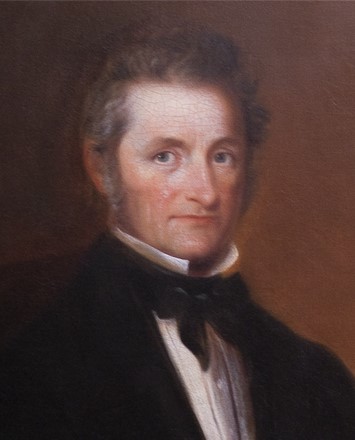
Hiram Capron
Content adapted from the Paris Museum and Historical Society and Wikipedia.
There were many community leaders in the early 1800s who persevered through difficult conditions to build the town we know as Paris; however, Hiram Capron was the community leader who was recognized as the person who founded Paris.
When Hiram Capron first saw the area we call Paris, it was empty fields, hills, an abundance of trees and two connecting rivers. He saw beauty and opportunity before him, but it was years before his goals could be realized.
The town of Paris, Ontario, was first settled in May 1829 when Capron bought land at the Forks of the Grand (as it was called at the time) and divided it into town lots. Capron built a grist mill, which grinds cereal grain into flour and was also involved in opening an iron foundry and in the mining of gypsum.
Capron was born and raised in the town of Leicester, Vermont, in 1796 to a family of farmers and moved to New York as a young adult to work for an iron-founder as a bookkeeper. Sometime later, Capron purchased a plot of land in Norfolk County by Lake Erie and erected a new blast furnace in 1822, and he was travelling the province selling ironware.
In 1823, Capron passed through the area then known as The Forks of the Grand River, where he met William Holme, who owned most of the land that now makes up Paris. The region was primarily undeveloped but included a small plaster mill, which likely indicated the area’s economic value to Capron. He was eventually able to buy the land from Holme and, in 1829, prepared to move to his new home. By 1835, Capron owned a reported 1,600 acres in Paris.
Once Capron had moved to the Forks of the Grand River, he set about clearing the land and dividing it into lots so he could lease it to settlers in order to encourage the growth of a community. He also undertook the development of Governor’s Road to permit trade and further enhance the growth of the village. Capron also began developing his land along the Nith and Grand Rivers into raceways to supply water power, which would spark the development of the town’s manufacturing industry.
The community of 1000 people was growing and had three mills, a tannery, a woollen factory, a foundry, and numerous tradespeople. The village of Paris was incorporated in 1850 with Hiram Capron as the first Reeve, and it was incorporated as a town in 1856.
If you are interested in the history of Pars, Visit the Paris Historical Society in the Syl Aps Centre. They have some fantastic displays and lots of historical resources. You can also learn about our history through the two-volume set of books At the Forks of the Grand. Volume One, written by Donald Smith and John Pickell, was first published in 1956 and re-printed in 1980. The second volume was published in 1982 and was written by Donald Smith. The County of Brant library has copies, and I found my set through an online antique bookseller.